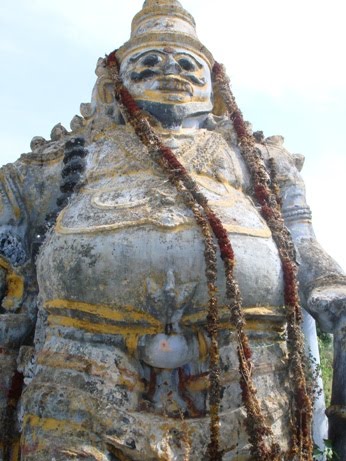
I Visited this temple almost a year back.. Suddenly had a feeling to share the information about this temple and hence posting it here...
-----------------
When one mentions about shrines of Lord Ayyappa, many revered places of worship, including the most famous Sabarimala, come to the minds of devotees across the country.
But the Lord has taken abode in a tree at Tummagunta of Vidavalur mandal of Nellore district, which may not be known to many, including the ardent devotees of Lord Ayyappa. The 15th century temple, which is associated with many legends, is now catching the attention of devotees.
Significantly, huge quantity of camphor is lit at the temple to coincide with the appearance of Makara Jyothi in Sabarimala on the day of Makara Sankranti every year. The temple also conducts Laksha Thulasi Archana on the full moon day during Karthika month.
According to ‘Sthala purana’ or local history, Vijayanagar Emperor Sri Krishna Devaraya, who was on his way back from the South to his capital, desired to take rest for some time at this place along with his soldiers, their horses, elephants, etc. Impressed by the nature’s pulchritude at this place, the emperor decided to construct a village there and asked some of the Brahmin families in his entourage to settle down there.
Accordingly, the Dravidian Brahmin migrant families originating from Taamraparni river basin, which is on the Kerala and Tamil Nadu State borders, settled at Tummagunta. They planted a ‘Juvvi’ (Pluksha in Sanskrit) tree and Indian rubber fig tree.
The Lord, who is fond of his devoteed followed them right from Tampraparni and manifested here in the form of tree.
Moreover, the temple possesses a rare painting of Lord Ayyappa that depicts Him riding on a lion, with bows and arrows in His hands.
Though you dont find any idols or vigrahams this temple is called Poorna Pushkala Samedha Shri Gurunatha Sastha temple and the pooja is done to the Tree itself.
The Master of the Universe - reveals himself in his Majestic and Munificent form in his favorite Kirata Vesham along with his Shakthis - Poorna and Pushkala
(Photo Shared by Shri. Hari ShankaraNarayanan, Banglore)
800-year-old Sastha statue discovered recently at Periyapuliyur, near Kavindapady. – An 800-year-old statue has been discovered at Periyapuliyur, near Kavindapady. The idol is Lord Sastha with his consorts Puranai and Pushkalai.
According to the Curator, Government Museum, Erode, C. Maheswaran, the idol is easily 800 years old and belongs to the early Chola period. While the left hand rests on the left leg, raised to the knee, the right hand holds a whip. The consorts are seen with fans. The Local people call it Iyyanar.
The Vigraham, in half-buried condition, sports a halo-like hair dressing, which is curled at the end. It appears like a halo. Ancestors worshipped the idol as a deity guarding the village, says Dr. Maheswaran.He says it was found in a rivulet near Periyapuliyur, when the water receded. The villagers on discovering brought it to the local temple, where it is worshipped to date. At present it is at the Chamundi Muniappan village, where people from all communities worship the deity.An interesting aspect of the temple, the curator says, is that deities worshipped by different communities find a place there. They are clan deities and members from all the communities go there to offer prayers.
One of our friends, Mr.Kamesh from Mumbai wanted to know about Plavadi Sastha temple...
Mr.Srinivasan from Mumbai was also asking me about this temple for a long time...
Let me try to present few facts which are available
V. Aravind Subramanyam
-----------------------
Plavadi Sastha
Plavadi sastha is one of the oldest Sastha shrines located near the banks of Tamrabarani... This beautiful temple is near kallidaikurichi, (near tirunelveli).
Swami is Swayambhu here who is very much pleased in sitting under a pala maram (jack fruit tree). Swami doesnt have any swaroopam here.. instead he is worshipped in the form of a lingam;
There are Three lingams ie Sastha in centre and on either sides Poorna and Pushakala - His consorts.
A idol of an elephant, His vahana is found infront of Swami. There is a peetam nearby Sastha which may be Lord Boothanatha.
The temple also houses a huge figure of Parivara....
Though there is a temple compund, Sastha is worshipped in the open space - just under the shelter of the Jack tree.. (Jack =Pala; ie Palavadi = Plavadi) without any sanctum sanctorum and Swami prefers to be in rain and sun than inside the Garbha gruham
Swami is very powerful here and Kshipra Prasadi [ NOT ONLY HERE !!!! ALWAYS !!! :) ]
This is an age old temple and Plavadi Sastha is the Kuladevivam of many people who live allover the globe.
The interesting and amazing fact about this temple - during any special puja to the Lord, after the puja, if He is satisfied with the worship, exactly three leaves from the Jack tree fall on the figures of Sastha-Poorna and Pushkala....
Since you dont have any facilities here... people halt at Kallidaikurichi and then come to this temple for worship.
Heard that the temple's Kumbabishekam happened very recently (last month)
Iam searching the additional information.. if anything available I shall update it immediately.
Who is Mampazhathurai bhagawathi and what is her connection with Sastha. My friedn told me She is Pushkala whom Sastha marries at Aryan Kavu.
But it is also told Sastha Thirukalyanam at Aryankavu does not happen and that why she is kept alone at mampazhathurai and so she is angry? is it right.
The serial "Swami Ayyappan" gave a diiferent version. What is the actual fact.
This is a very big doubt iam having for a very long time. I dont find the direct relationship of Mampazhathurai Bhagawathi with Sastha Thirukalyanam at aryankavu - except the fact that the sourashtra people go and worship there before commencing the marriage.
As per the local lengend of Aryankavu if it is Pushkala.... there are 2 stories around this... let me first present these stories...
Story 1:
Ayyappan married this Girl at Madurai and brought her to Aryankavu / Achankovil... once Ayyappan hunted a deer and to his shock this girl started cooking it... Since Ayyappan is "VEGETARIAN" he ordered her to stay out of his temple premises and thus She stayed here.. and so she is angry because her husband neglected her... (this story style itself says it is too much Folklore.....)
Story 2 :
This sourashtrial Girl fell in love with ayyappan at Aryankavu and The Lord accepted to marry her.. the Marriage date was fixed and exactly the day before her marriage this girl had her periods and so marriage was stopped.. Ayyappan was very angry and understood that it was a test to his celibacy and so decided not to marry and asked her to stay at Mampazhathurai as a deity.. (The marriage would have taken place at subtle plane like Andal and definitely not as stated in this story... this infact pulls down the divinity of Sastha.. this Episode was further treated with all Garam Masala with Malayala Manthereekan etc in "Swamy Ayyapan" serial and made the girl Pushkala almost to an extend of a Ghost )
I'l give 90% discount to the depictions shown in Swami Ayyappan serial... It is very much clear that, with one line information they have developed screenplay to drag the episodes... (if you can remember the serial, please recollect.....
* they picturised Achankovil as Sastha sitting alone without devis
* there was hardly a mention about Poorna pushkala and only once - they gave a wonderful statement that Poorna and Pushkala -both are same
* The marriage at Aryankavu doesnot takes place.. only the engagement takes place...
this was carried out to "ESTABLISH" sastha is a bachelor, a famous notion in Kerala...
Both these stories are absurd according to me. The marriage happened at Aryankavu between Sastha and the Sourashtra girl is not on physical plane but pure merger - "Aikyam" of the devotee with the Lord. This can be compared to Andal and Ranganatha's marriage. This is an ultimate state of supremeness and so the question of running a household and cooking vegetarian/nonvegetarian does not arise.
This story is further treated with salt and pepper by some more people. Also there is a romour spread that only the engagement happens there and not the marriage. But this is not true. The marriage very well happens every year and the devi is very very happy always. Remember the devi with Sastha at Aryankavu is benign-sowmya swaroopini; (carriying a lotus) whereas Mampazhathurai Bhagawathi is ugra swaroopini. The form itself varies completely.
Please understand, the Thirukalyanam between Sourashtrian Pushkala and Sastha at Aryankavu is an example of supreme devotion and the state of oneness with the Lord, something similar to Radha Kalyanam.
According to my findings, Mampazhathurai Bhagawathi must be Yakshi who is an important parivaram of Sastha.
You can see she carries Trishoolam and kapalam which exactly fits into the dhyanam of yakshi.
I have deciphered the incident (in the following manner) with my very little knowledge and observation : (I have heard that there is a detailed mention of Aryankavu in Mahothra Purana or Mahendra Purana... but i could not even get any trace of the book.. Iam still searching it)
Aryankavu is a shrine which was installed by Parasurama as Prabha Sathyaka Samedha Sastha...(as Swambhu Stones like Kulathupuzhai).. The Panchaloka idol which is there today may be of a later date... Very much later... after the Sourashtrian settlement in Madurai (maybe maximum within 5 or 6 centuries ago), this Girl who was highly devoted to Sastha came to this temple along with her father.. (her name is not clear in the available versions of the stories) Exactly like Andal, who married Ranganatha in the subtle plane and merged with the Ranga idol in the Shrine, this devoted girl married Aryankavu Sastha and merged with him...
In memory of this divine leela, this marriage celebration by the Sourashtrian community would have originated...
Just because she is seated in the left side of the Lord she may be called Pushkala....(considering her as an amsha of original Pushkala) or by a remote chance - her original name itself maybe Pushkala.
Bagawathi is a very common name given to any female deity in Kerala.. this necessarly need not be her name...
I've heard about the rowdra Swabhavam of Mampazhathurai Bhagawathi... one of the disciples of my Grandfather told me the following incident about his personal experience...
Some 2 or 3 decades ago, he met my grandfather(Chaami Anna) and casually informed that he is also planning to go to this temple. Knowing that he is always hyper active, my Grandfather warned them about this temple and advised them just to have the darshan and donot do anything of their own without proper guidance. When their group reached this place, it was all alone and no one was there... and the temple gate was also closed.. they thought of doing Lalitha Sahasranama Kunkumarchana and so they opened the gate and entered there...
So they sat in front of the temple... placed a leaf and started the archana... even before they could complete 3rd nama, a Monitor Lizard (udumbu) fell exactly on the Trisulam which was planted nearby and it blood splashed all over the area, including the Puja place... They felt this as a bad omen and immediately vacated the place...
Mampazhathura is near Nagamali Estate in Kazuthuruthi near Punaloor. The local people claim her as Madurai Meenakshi. (You may be aware that Yakshi is often identified with Meenakshi or Rajamatangi in most of the Varavu songs clearly attributed in his songs by Manidasar.. who is the Supreme court - with respect to Sastha) Inscriptions on the stone is surprisingly in Tamil only and the temple is pretty old one from its look.
Remember Mampazhathurai Bhagawathi is also related to Achan kovil.
These fact give us an idea that Mampazhathurai may be a Yakshi Kavu - a favorite parivaram of Sastha
Iam just presenting my view here and I'l never pass any Jugdement with Swami...
Who can give judgements with our Swami's vaibhavam?
The Vedas declare the nature of the Supreme Truth in many ways. Sometimes they call It Brahman (the great and glorious essence);
other times they call it Sat (Being); still other times they call it Purusha, other times Vishnu, Rudra, Atma, Paramaatma, etc. How are we to reconcile all these various names? Surely they all refer to one Supreme, as the Vedas declare that there is only one Supreme Cause -- ekam eva advitIyam.
It is beyond doubt that Lord Maha Sastha is the Supreme Being described in the Vedas.
Fortunately, the Vedas themselves offer a reconciliation of all these names, contained in the various Upanishads and even in the text of the Veda proper. In the Purusha Sukta, found in all four Vedas, the Supreme Brahman is described as the being who exists everywhere. This most important Vedic hymn praises the transcendental "cosmic man" – the Parama Purusha, the personification of the all-pervading Brahman- who is none other than “Sastha”
There are even more direct Veda vaakyas on our Lord Sastha.
In the Yajur Veda, we see for example,
“Sastha adhipathir vo asthu” - (Sastha is the ultimate ruler), a reference to the supremacy of Sastha over every being.
The Maithrayini Upanishad Says
“Brahma, Vishnu, Shiva, Sastha, Pranava and Brahman – is one and the Same”.
The Kalagni Rudropanishad calls Shiva as “Sarva Sastha”
These Veda vaakyas clearly spell out the principle that the concept of Sastha encompasses all other deities. Even otherwise, the meaning of the word “Sastha”has perhaps the deepest philosophical significance of any name of God, over and above even the terms Vishnu, Siva, Brahma, Indra, etc. The latter terms respectively mean “pervader”, ``pure'', ``great'', and ``king'', and are applicable to any number of things, including the individual self. However, Sastha means ``One who rules all the creatures'', which by implication can only refer to the Supreme.
Though the Sastha temple at the holy Sabari hills is very famous, it is to be noted that there are innumerable Sastha shrines throughout the country. Sastha is not only the Lord who is in Sabarimalai… Infact Lord Sastha is the actual source for Ayyappa incarnation..
Lord Sastha is the Primary force; He has two consorts – Poorna and Pushkala. Sastha has taken eight divine incarnations for His divine missions. Out of his eight incarnations, the most popular avathara or incarnation is stationed at Sabari hills as Ayyappa (as brahmachari or bachelor).
But Maha Sastha as a principal force, resides in his abode as Poorna Pushkala Sahitha Hariharaputra. Even during the Vedhic age when deities were worshipped only through fire, Sastha had a significant position and was worshipped in stone idols. The Vedhic seers (rishis) who lived in dense forest had Sastha as their ishta devata and that is reason we find numerous Sastha shrines in the forest area today.
Thus, Sastha’s worship who is the Supreme Lord of the Vedhas will bestow health, wealth and all the good things in life one can desire... and also grant moksha after the life.
It is to be noted that that Lord Hariharaputra is the most celebrated Lord among the Vedhic community of Brahmins. He is the Ishta devata, Para devata and Kula devata of them. During the magnificent Sastha Preethi celebrations held at every nook and corner of the world today, one can witness the significant role of the Vedhas in the rituals.
Sastha is called “Vipra pooja” – one who is worshipped by the Vedhic Scholars.
All our saints and ancestors have stated unambiguously that in Kaliyuga, Sastha’s worship is the only way of salvation.
“Kalau Sasthru Vinayakau”- Sastha is the only master in Kali
It is true that the Vedas themselves often praise other gods. However, it should be understood that that the personality to which the vaakyas refer is only Maha Sastha – the ultimate divine force.
Among the most important duties of Vedhic Bramins, the Vedhic Yagnas stands first. Vedic yajnas such as Vajapeya, Pashubhanda, Jyotistoma, Ashwamedha are well known. Out of the forty samskaras a human has to perform, these Vedhic yagnas are to be done at least once in a lifetime. This is of top-most value in the life of every householder. Whatever he gets from his farms, from his trade and commerce, whatever he earns from his job, must be shared with other members of universe.
If one observes the Hariharaputra Sahasranama carefully, it will be evident that Sastha is explicitly described as the Lord who gives the fruit of these Vedhic yagnas.
Namas which clearly explains the Vedhic yagnas which are not to be found even with the famous Vishnu, Shiva or Lalitha Sahasranamas are very clear and continuous in Sastha’s Sahasranama.
From the namas like Dwadasaahakrathu preethaa, Aptoryaamakratu mayaa, Poundareeka Phalaprathaa, Pasubhanda phaladhaathre, Vaajapeyathma Daivatham etc – the only point being made is that the ultimate Truth explained in the Vedhas is none other than Lord Maha Sastha.
Taittria Aranyaka Says:
Anthah Pravishtas Sastha Jananaam Sarvaathma |
Sarvaa: Praja Yathraikam Bavanthi |
"Where all are united, He who has entered within, that are born, and is the self of all, is beyond comprehension, He is Sastha the ruler of all things”

 When one mentions about shrines of Lord Ayyappa, many revered places of worship, including the most famous Sabarimala, come to the minds of devotees across the country.
 Accordingly, the Dravidian Brahmin migrant families originating from Taamraparni river basin, which is on the Kerala and Tamil Nadu State borders, settled at Tummagunta. They planted a ‘Juvvi’ (Pluksha in Sanskrit) tree and Indian rubber fig tree.