Protected by Copyscape Website Copyright Protection

Wednesday, March 18, 2015

Sastha Preethi Mahothsavam of Shri Maha Sasthru Seva Sangam Coimbatore

Sastha Preethi
Hariharaputra Mahothsavam of Shri Maha Sasthru Seva Sangam Coimbatore

Dates:            13-14 June 2015
Venue:            Ramnagar Ayyappan Puja Sangam Kalyana Mandapam, Coimbatore 12

Respected Devotees, 

Shri Maha Sasthru Seva Sangam feels privileged to write a few lines to everyone of you.

By the divine blessing as the guiding force, we are stepping into this year's pooja celebration - to be conducted as 2 days program at Shri Ayyappan Puja Sangam, Ramnagar, Coimbatore.  

Pujas of yester years were a Mega success,by the grace of Lord Ayyappa. This became possible ONLY due to your overwhelming response, moral and financial support. 

This year's puja is to be conducted with the presence of presence of many eminent personalities. Sri Mahesh Mohanaru, Supreme Priest (Tantri) of Sabarimala has gracefully concented to conduct the Puja.

Evening procession is accompanied by Chottannikkara Subash Marar and team's panha vadhyam. The Coconut breaking is by Sri Ramachandran Nair, Velichappad of Balussery Kotta

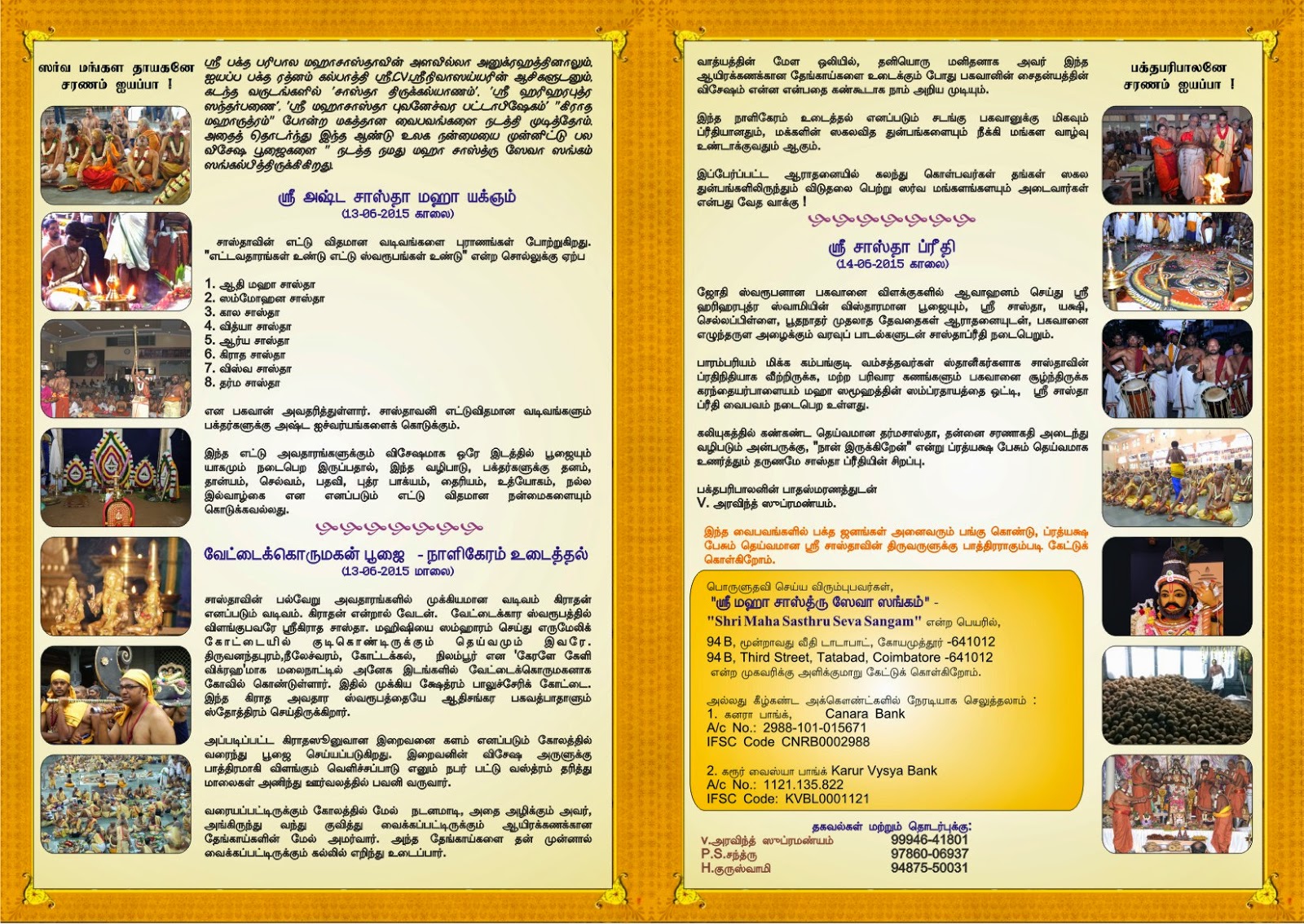
The Invitation copy for this year's festival 

English


Tamil 


Written a brief account on this event below

Please make yourself convenient and be present for both the days with all support.

We earnestly request all devotees to attend this auspicious pooja and get the blessings of Lord Sastha.

Those who wish to contribute to this Puja, may send Cheque / MO / DD in favour of :
"Shri Maha Sasthru Seva Sangam" to V. Aravind Subramanyam, Thejovathy, 94 B, Third Street, Tatabad, Coimbatore 12. Ph: 099946-41801

Or You may pay directly to our Bank Account :
Name: "Shri Maha Sasthru Seva Sangam"

Karur Vysya Bank A/c No. 1121 135 822
IFSC CODE - KVBL0001121
Nanjappa Road Branch

or

Canara Bank A/c No. 2988 101 015671
IFSC CODE - CNRB0002988
PSG Arts College Branch


Devotees who donate can mail us your Name and Nakshatram and the Address so that it will be included in the Puja and we can send you the prasadam.

Looking forward to your active support to celebrate this function of "OUR" Lord.

Contributions in way of Cash or Kind / Materials :

Flowers Rs. 5,001 (Per Session)

Puja Materials Rs.5,001 (Per Session)
Materials such as Rice Bags, Vegetables, Milk, Coconuts,Oil tin, Ghee tin etc

Annadhanam (Full Contribution) Rs.75,000 (Per Day) or
Annadhanam (Part Contribution) Rs.10,000 

(All these are indicative only) Any small contribution to the above event would make it very successful and obtain the blessing of Lord Dharma Sastha.

For Details You may Contact
Ph: 099946 41801
Email: mahasasthru@gmail.com
---------------------------------------------------------------------------------

With the boundless blessings of Our Baktha Paripala Sri Maha Sastha, and blessings of Ayyappa Bhaktha Ratnam ,Kalpathy Sri C.V. Srinivasa Iyer, we were blessed to conduct many unique events like “Hariharaputhra Brahmana Santarpana Vaibhavam”, "Sastha Bhuvaneshwara Pattabhishekam", "Kiratha Maha Rudram". 

This year, Shri Mahasasthru Seva Sangam, has ordained to perform the unique event of “Ashta Sastha Maha Yagnam" and the annual Sastha Preethi Mahotsavam, on June 13 & 14, 2015.

ASHTA SASTHA MAHA YAGNAM 13-06-2015: Morning

The Karunyam of the Almighty, Sri Maha Sastha is immeasurable. Our gratitude to the Great Lord can be expressed in many ways. Lord Sastha has taken eight different incarntions in the world for the welfare of mankind.

1. Adhi Sastha
2. Sammohana Sastha
3. Kala Sastha
4. Vidhya Sastha
5. Arya Sastha
6. Kiratha Sastha
7. Viswa Sastha
8. Dharma Sastha 

All these eight forms bestow the eight aishwaryams to the devotees.

A special yagnam to all these eight forms of Sastha is to be conducted at one place. This would happen only by the divine grace and which would grant Wealth, Health and long life, Happiness, Strength and Courage, Culinary skills, Skills in arts, Success, Happy Family life 

NALIKERAM ERRU 13-06-2015 Evening

Lord Kiratha Sasha is praised as the son of Lord Shiva and Parvathi, born when he assumed the form of a Kirata (hunter) to deliver a weapon known as Pashupathasthra to Arjuna. He is one who is worshipped in Erumeli Kotta. He is worshipped in most famous temples of Kerala like Balussery Kotta, Nilambur, Trivandrum Kizhakke Kotta etc

After a procession of the Lord on a caparisoned elephants, a drawing of Lord Vettakkorumakan (Lord Sastha in the form of Kirata Murthi) is made with powder of different colours. In the background of playing percussions (Chenda), the Velichappad, a member from a traditional starts breaking all the coconuts single-handedly to the awe of all. He does this performance after observing Vratha (penance) for many days.

This puja is done as a very special offering as stipulated to please Lord Kiratha Soonu for invoking His Grace and Blessings and all negative forces are removed and the devotee is bestowed with all that is good.

SASTHA PREETHI

Sasthapreethi is a time tested mode of worshipping Lord Dharmasastha in a very religious way by various samoohams and organizations in and around Kerala, and now in all parts of the country and abroad. The religious pooja is given more importance followed by Annadhanam.

The priest invokes Lord Ganapathi, Ambal and Dharma Sastha and His attendants (Parivara Devathas) on tall brass lamps decorated tastefully. 

After the detailed puja, neivedyam and deeparadhana followed by mantrapushpam a detailed Veda Parayanam is made. After appeasing the Lord with Vedha gosham, the traditional Sastha paattu (Varavu Paattu – inviting Songs) songs are sung. 

While singing, the traditional upasakas or Sthanakaras of the respective deities gets into a trance and gets the supreme power invoked within them. In General Sastha, Chellapillai, Yakshi and Boothathan are the deities who are invited. These Sthanikas are offered respect by the devotees and upacharas are done to them. They are seated on the wooden plank and are decorated with garland and sandal paste. 

They bless the devotees with prasadam and convey the deity's satisfaction in the conduct of the Sasthapreethi. People prostrate before him, get blessed and receive Vibhoothi as prasadam. 

Very rarely a Yajna of this significance and magnitude can be witnessed and the opportunity for the people to actually participate in the worship. It is also done particularly for the sake of washing away ones sins and afflictions, for bringing peace, prosperity and family happiness.

So, the Bhakthas who are taking part in this magnificent event can be assured of obtaining the limitless blessings of Sri MahaSastha and getting all their prayers fulfilled.

May Lord Hariharaputra be with you always, giving you the best of everything.
Swamy Sharanam
V.Aravind Subramanyam

Tuesday, November 11, 2014

Ponnambalamedu

Swamy Sharanam

As per the request from many devotees, Iam writing few words about the Ponnambala medu. I shall elaborate on this subject with the second part of Shri Maha Sastha Vijayam which Ive started already working

Baktaparipala Pada renu
V.Aravind Subramanyam

Lord Sastha, the Supreme master is being worshipped at Various temples. When Parasurama created Kerala, he requested the Supreme Lord to protect his land. Sastha was pleased with the penance of Parasurama and he appeared before him.

 Lord Sastha promised him to stay in the land of God's own country and instructed Parasurama to build as many temples. 108 Sastha Temples are listed as Nuttiettu Sasthalayangal. Aong which one temple is called Aadhi Moola Kshetram or Sri Moolam Kavu.


During my long research for writing my book "Shri Maha Sastha Vijayam", I was searching for the book Shri Boothanatopahyanam- which actually contains the puranam of Sabarimala. Though till date I couldnot get the full text, by Bagawan's grace we could trace few chapters of the book.


The book contains one exclusive chapter titled "Swarnalaya Pratishta" which talks about a place called ponnambalamedu.

Bagawan Manikanda, during his human incarnation came to the forest. The Rishis and Yogis were doing penance at Veliyanavattam. They received the Lord wholeheartedly and wanted to perform puja to him.

tatrANgatasca bagawat tApasA bakti sAlina:
cakrirE bUtanAtasya pUjanam

The place is sanctified because the Rishis, Yogis and tapasvis made the Lord sit on a throne and did puja to the Akilanda Koti Brahmanda Nayaka.

The text says, Amidst dense beautiful hill the Maharishis, with their power, created a place for their penance. They created a Golden temple.

ramyE parvata srngAgrE tApasAsca tapObalAn
krtvA rkmAlayam tasminandarE maNikandaram

They made Lord Maha Sastha to occupy the central golden throne and then worshipped him.
ratna simhAsanE ramyE samstApya sakalEzwaram 

This place became the most sanctified place of the entire universe. And later after the purpose of the avataram was acheived, Manikandan came back to this spot and merged with this maha peetam.

This is the holiest of the holy spots, where the Supreme Lord Maha Sastha resides with Poorna and Pushkala, His eternal consorts and countless other devotees, from where he performs his divine play, known as leelas.

When we research further, the main question comes.. where is it located?

The text gives answer for that too.
dUrE paNca dwayE dEvayOjanAyAm tu tatra ta:
its located at 10 deva yojana distance from Pampa

According to Valmiki Ramayana one yojana is equated to 9 miles. So 10 yojanas = 90 miles. Moreover its given Deva Yojana. One devayojana=1000yojanas.
So on the whole it means, 90 x 1000 = 90000 miles. This is humanly impossible. (Thats why its deva yojana)

Which makes it clear that this Golden temple on Ponnambalam is not a place which exists in the physical plane. It cannot be seen with the naked eyes.

Just like Kailasam and Vaikuntam... they exist but you cannot see them...

 Even for 108 Vaishnava Divya desam only 106 is there in this world. Remaining 2 are to be seen in the other world.

Similarly this ponnambalamedu or Kanthamalai is a place which exists in the subtle plane and cannot be seen with the naked eyes..

Since one cannot reach here directly,  some people consider the present Ponnambalamedu to be the Kanthamalai of Bhoolokam..

Ponnamblamedu - the mound of pon ambalam - Golden Temple....

The rahasya behind this place- to remind the original Swarnalaya Pratishta done by Rishis, exactly at this actual spot Parasurama installed the Adhi Moolasthanam - Temple of Sastha (Which probably might have been in Gold - as the name suggests).

'Makaravilakku' is the only festival here.  The celebration of  'Makara Samkramam' in this temple is now known as 'Makara Vilakku'.

Later during the historic period, this temple was destroyed and looted by a dacoit named Udayanan..  

Ancient texts like Kerala Kalpam or Boothanaothopakhyanam name this temple as 'Sree Moolam Kavu'. This is the original point of today's 'Sabarimala' temple. 'Makarajyothy' usually appears above the top of this hill.

We dont find any temple there now.. nothing is to be seen now... today we see a yantram with "XX" beejam engraved there... 

It is the most sacred and divine place... The spot is very sacred and the divinity charged there in the atmosphere is beyond imagination.. But that is the state of ultimate bliss,  contentedness, a feeling of fulfillment.

Tuesday, November 4, 2014

Arul Osai -Call me to hear about Ayyappa

Swamy Sharanam
Iam talking about the glories of Swamy Ayyappan thru Sakthi Vikatan.

Call to (+91) 044-66802913 to hear me on "Arulosai"
Sharanam Ayyappa
Aravind Subramanyam

Monday, September 22, 2014

"Shakthi" - devi darisanam'


Swamy Sharanam
"Shakthi" - devi darisanam'

My lecture series on Devi - now being Aired on Swasthiktv.com 

Its an Online Channel so you can just logon to www.swasthiktv.com  and watch the program.

Please watch and get blessed

Time: Every Tuesday 7.00 AM and Retelecast on Tuesday 7.00 PM

Starting from today, Those who missed it, plz watch today 7.00PM

Thanks

Thursday, August 28, 2014

Swami has arrived - Sasthalaya Sevanam


Swamy Sharanam

We have been doing the Sasthalaya Sevanam - renovationg dilapidated Sastha Kshetrams.
(For those who are new you may visit here http://shanmatha.blogspot.com/2010/09/sasthaalaya-sevanam-movement-for.html) for the past 3 years...

Ive already written about our involvement with this temple ( Details given here : http://shanmatha.blogspot.in/2014/05/sasthalaya-sevanam-kiratha-sastha.html and
http://shanmatha.blogspot.in/2014/07/result-of-devaprasnam-sasthalaya-sevanam.html )
Lord Kirathan

Kannimoola Ganapati
As instructed by Bagawan and with the support of devotees we had ordered for Shila Vigraham for Lord Kiratha Sastha and Ganapathy and Panchaloka Bimbam for Devi.

The stapati had told us that he needs atleast 20 more days to complete the vigraham. Today morning, (being the auspicious Uthra Nakshatram), we had call from the Stapati informing that the Stone Vigrahams are ready. Without any delay we rushed to the spot and we were astonished to see the black beauty - ashyama komalan - Lord Kirathan.
 
Opening the Eyes
Puja by the Stapati

 The Stapati did his own rituals and pujas to complete the vigraham and opened the eyes. The ever merciful Lord in all his majesty is now ready to bless his devotees. Along with him is Lord Ganesha - to remove all our hurdles and to witness tomorrow's Chaturti.

Now we also got a phone call that the Gopura Kalasams are also ready. - All happening in the same day ... !!!

Bagawath Sankalpam...

As suggested by the Lord - it is evident that the Lord is happy about the present happenings and We are sure that, as promised by HIM, he is directly blessing the devotees who is taking part in this venture.

We are awaiting for the next process of completing the Srikovil and Kumbabhishekam of the temple.

Vettakkorumakane Sharanam Ayyappa !!

Tuesday, August 12, 2014

மஹாம்ருத்யுஞ்ஜய மந்திரம்


இது மஹாம்ருத்யுஞ்ஜய மந்திரம் என்ற பெயருடையது. ருக் வேதத்திலும் (7.59.12) யஜூர் வேதத்திலும் (1.8.6.i; VS3.60) காணப்படுகிறது. இம்மந்திரத்தைக் கண்டறிந்தவர் மார்கண்டேய முனிவர். இது முக்கண்களையுடைய சிவபிரானிடம், சாகாமையை  வேண்டுவதாக அமைந்துள்ளது.
ஓம் த்ரயம்பகம் யஜாமஹே ஸுகந்திம் புஷ்டிவர்தனம் l
உர்வாருகமிவ பந்தனாத் ம்ருத்யூர் முக்ஷீய மாம்ருதாத் ll

சொற்பொருள்:-
ஓம் = ஓம்; த்ரயம்பகம் = முக்கண்ணுடையவரே; யஜாமஹே = நாங்கள் உம்மை யாகத்தினால் பூசிக்கிறோம்; சுகந்திம் = நறுமணமும் (எல்லா வளமும்); புஷ்டி = ஊட்டமும் (எல்லா நலமும்); வர்த்தனம் = பெருகும்படியாகச் செய்பவரே; உர்வாருகம் = வெள்ளரிப்பழம்; இவ = போல; ம்ருத்யோர் = (என்னை) இறப்பின்; பந்தனாத் = பிடியிலிருந்து; முக்ஷீய = விடுவித்து; மா = எனக்கு; அம்ருதாத் = இறவாமையை அருளும்.

மந்திரத்தின் பொருள்:-
ஓம் முக்கண்ணுடையவரே! எல்லா வளமும், எல்லா நலமும் பெருகும்படிச் செய்பவரே! நாங்கள் உம்மை யாகத்தினால் பூசிக்கிறோம். வெள்ளரிப் பழம் போல, என்னை இறப்பின் பிடியில் இருந்து விடுவித்து, எனக்கு இறவாமையை அருளும்.

விளக்கவுரை:-
ஓம் என்பது எல்லா மந்திரங்களுக்கும் பொதுவானது. அதைத் தனியாக உச்சரிக்க சன்யாசிகளுக்கு மட்டுமே உரிமையுள்ளது. ஆகையால், மற்றோர்களும் அதை உச்சரித்துப் பயன் பெற வேண்டும் என்பதற்காக, அந்த ஓரெழுத்து மந்திரம் அனைத்து மந்திரங்களுக்கும் முதலில் உச்சரிக்கப் பெறுகிறது. இங்கும் அதுவே பின்பற்றப்பட்டுள்ளது.

சிவபிரானுக்கு மற்ற பல அங்க அடையாள, அணிகலன்கள் இருக்க, இங்கு அவர் முக்கண்ணரே! என விளிக்கப்படுகிறார். காரணம், மற்றெந்த தெய்வத்திற்கும் இல்லாத இந்தச் சிறப்பை உடையவரே, மற்றெந்த தெய்வத்தாலும் அளிக்க இயலாத, பின்னால் கேட்கப் போகும் (இறவாமை என்ற) வேண்டுகோளை நிறைவேற்ற சக்தியுள்ளவர் என்று சுட்டிக் காண்பிப்பதற்காகவே ஆகும். மூன்றாவது கண்ணால் காமவேளை எரித்தவருக்கு, அதேபோல, யமனை எரிப்பது ஒரு பெரிய காரியமல்ல என்று கூறுவதுவும் ஏற்புடையதே.

சிவபெருமான் காரணமின்றியே, அவர் மீது பக்தி இல்லாவிடினும், அருள் செய்து (இதற்கு வடமொழியில் ’அவ்யாஜ கருணா’ அல்லது ’நிர்ஹேதுக க்ருபா’ என்று பெயர்), நறுமணத்தையும், ஊட்டத்தையும் அளிக்கிறார். அவர் மீது நமது பக்தி கூடக் கூட, அவற்றை அதிகரிக்கச் செய்பவர் என்பதையே ’வர்தனம்’ என்ற சொல் உணர்த்துகின்றது. நறுமணம் என்பது மனமகிழ்ச்சி, போன்ற உள்ளம் சார்ந்த வளங்களையும், ’புஷ்டி’ என்பது  உடலுடன் தொடர்புடைய நோயின்மை, சுகம் என்ற நலன்களையும் சுட்டுகின்றன. வடமொழியில் ’யஜனம்’ என்றால் யாகம் செய்தல் என்று பொருள். பொதுவாக பூசிப்பது என்பது பொருளானாலும் சிறப்பாக யாகத்தால் பூசிப்பதையே குறிக்கிறது.

மரத்தில் ஏற்றி விடப்பட்ட வெள்ளரிக் கொடியில் காய் காய்த்துப் பழுக்கிறது. பக்குவம் வந்தவுடன் பழம் கொடியிலிருந்து விடுபடுகிறது. நிலத்தில் விழும் அதற்கு என்ன நேருகிறது?  அதே கொடி நிலத்தில் படருகிறது, காய்க்கிறது, பழுக்கிறது. பழம் எடை கூடுதலாக இருப்பதால், பக்குவம் வந்தவுடன், பழத்திற்குச் சேதமில்லாமல், கொடி பழத்திலிருந்து விடுபடுகிறது. அந்த நிலையே இங்கு விளக்கப்பட்டுள்ளது. நம்மைப் தன்பால் பிணைத்து வைத்துக் கொண்டுள்ள இறப்பு, நம்மிடம் இருந்து விலக அருள் புரிய வேண்டும் என வேண்டப்படுகிறது. வெள்ளரிக்காய் பழுத்த உடனேயே கொடி அதை விட்டுப் பிரிவதில்லை. பக்குவம் வர வேண்டியதுள்ளது. அதுபோல, சாகாமையை வேண்டினாலும் பக்குவம் வரும் போதுதான் அதை அடைய முடிகிறது. அதுதான் குருவருள். இறையருள் கிடைத்தாலும், குருவருளின்றிக் காரியம் கை கூடாது என்பது இங்கே, அதாவது பக்குவம் வந்தபோது தானாக விடுபட்டுப் போகும் கொடியினால், குறிப்பாக விளக்கப்பட்டுள்ளது.

இறவாமை என்றால் என்ன? பிறந்த உடனேயே சாவதும் உறுதி. எவரும், எதுவும் நிலையல்ல; அப்படியிருக்க இறவாமையை எப்படி வேண்டிப் பெற முடியும்? இறவாமை, இப்பொழுது எடுத்துள்ள இப்பிறவியில் அல்ல. இனிப் பிறந்து-பிறந்து, இறந்து-இறந்து இளைக்காமல் இருப்பதுவே வேண்டப்படுகிறது. அதற்கு இம்மனிதப் பிறவி ஒரு கருவியாக இருக்கிறது. இம்மாதிரியான மந்திரங்களைச் சொல்லி, கேட்டு, சிந்தித்து, உணர்ந்து பயன் அடைய முடிகிறது.


எந்த மந்திரத்தை உச்சரித்தாலும்,  அதற்கேற்ற பயன் கிடைப்பது உறுதி. அதில் ஐயமில்லை. ஆனால் ஒலிநாடா சொல்லிக் கொண்டிருப்பது போலன்றி, அதன் பொருளறிந்து சொல்லுவது, பன்மடங்கு பயனை, உடனே அளிக்க வல்லது.        

- எழுதியர் ஸ்ரீ சாஸ்தா கோபால், கோவிந்தபுரம்

Sunday, August 10, 2014

Kamokarsheet Japam and Seshadri Swamigal

Today is Avani Avitam (Shravana Poornima) and its Upakarma for people belonging to Yajur Vedha. Rg and Sama Vedhis will be having their upakarmas subsequently.  

While performing the Upakarma how many of us try to understand the significance of the Upakarma and various aspects of Upakarma?

I was really glad when my dear brother Anand questioned me about one important part of the Upakarma  ie Kamokarsheet Japam

If we can observe carefully, the actual process of Upakarma starts with Kamokarsheet japam. Many of us just like that take it easy and do the Kamokarsheet Japam (though prescribed count is minimum 1008, most of the people do 108, 28 or even 11) 

On the upakarma day, a Praayaschittam (expiation) is performed on two counts - to pardon the sin of learning Vedas in the prohibited period of the year and a special request to pardon all the sins committed by them during the year. With this sankalpam we perform the Kamokarsheet japam.

We need to understand the very essence of the whole Karmic formula of Hinduism (or rather the human race ) lies in this Kamokarsheet Japam. Thats the reason its kept as a part of our Nitya Sandhyavandham and a special japam is suggested on the Upakarma day.

What is the purpose of doing this japam 1008 or 108 times?

Its not only a chant, but a great prayer or declaration to contemplate. 

As part of our life in this world, knowingly or unknowlingly, voluntarily or invluntarily we commit sins. Every action has an equal and opposite reaction. And this is the basic law for Karma and because of this, we all are bound by Karma. Kamokarsheet is a confession for all the sins committed by us during the year prodded by Kama and Manyu, avarice and anger. 

The Kamokarsheet Japam is orginally from the Mahanarayana Upanishad. 

In the mantra Kamoekarsheet Manyurakarsheet’ Namo nama:" -  both Desire (Kama) and Anger (Manyu) are raised to a special  status and salutations is given to them. Even gods are bound to  these qualities.

‘Kamokarsheet’ in Sanskrit means ‘those acts that are out of desire’.‘Manyurakarsheet’   means “those acts that are committed out of anger”.

It reminds us of all our sins and make us understand that  it is lust & anger that are the root cause of all our misdeeds, thus reminding us to be careful and vigilant.

An incident from the life our Gurunathar Seshadri Swamigal proves the importance of Kamokarsheet Japam for spiritual aspirants.

During his younger days at Kanchipuram, Swamigal was always engrossed in continuous and vigorous Japa and prayers. 

Many great scholars at Kanchipuram were always surprised to see the small boy sitting in the corner of the temple and murmuring something. 

Once, they all decided to question the boy and get an idea about what he is doing all these days.

They all went to Swamigal and called him.

"Oh Boy ! What are you doing" - they asked Swamigal

An immediate reply came: 
" I need to get rid of my Karma ; So Iam doing Japam for that"

The scholars never expected such a mature reply from a small boy. 

"What are you chanting for this purpose?"

Swamigal again gave an astounding reply  : 


"Kamokarsheet namo namah: Kamokarsheet
kamah karoti naaham karomi
kamah karta naham karta
kamah kaarayitaa naham kaarayita;
Esha the kaama kaamaaya swaha:

Manyurakaarsheet namo namah: Manyuh akaarsheet
manyuh karoti naham karomi
manyuh karta naham karta
manyuh kaarayita naham kaarayita;
Esha the manyo manyave swaha:"

Ive completed half my target, Iam yet to complete few more to get rid of my Karma.

He then explained the significance of the statement and also its actual meaning.

"Desire performed the act. Desire did the act. Desire is doing the act, not I (Self). Desire is the agent not I. Desire causes the doer to act not I. O Desire, fascinating in form, let this oblation be offered to thee, Hail!

Anger performed the act. Anger did the act. Anger is doing the act; not I. Anger is the agent; not I. Anger causes the doer to act; not I. O Anger, let this oblation be offered to thee. Hail! " 

The small boy suggested the veteran scholars 
"Dear Sirs, even you people start chanting this; Only this can kill karma. And without getting rid of Karma how can you qualify for Moksha (salvation) ?"

"Kaamah Karoti Naaham Karomi ; Kamoekarsheet Manyurakaarsheet’ Namonama:"